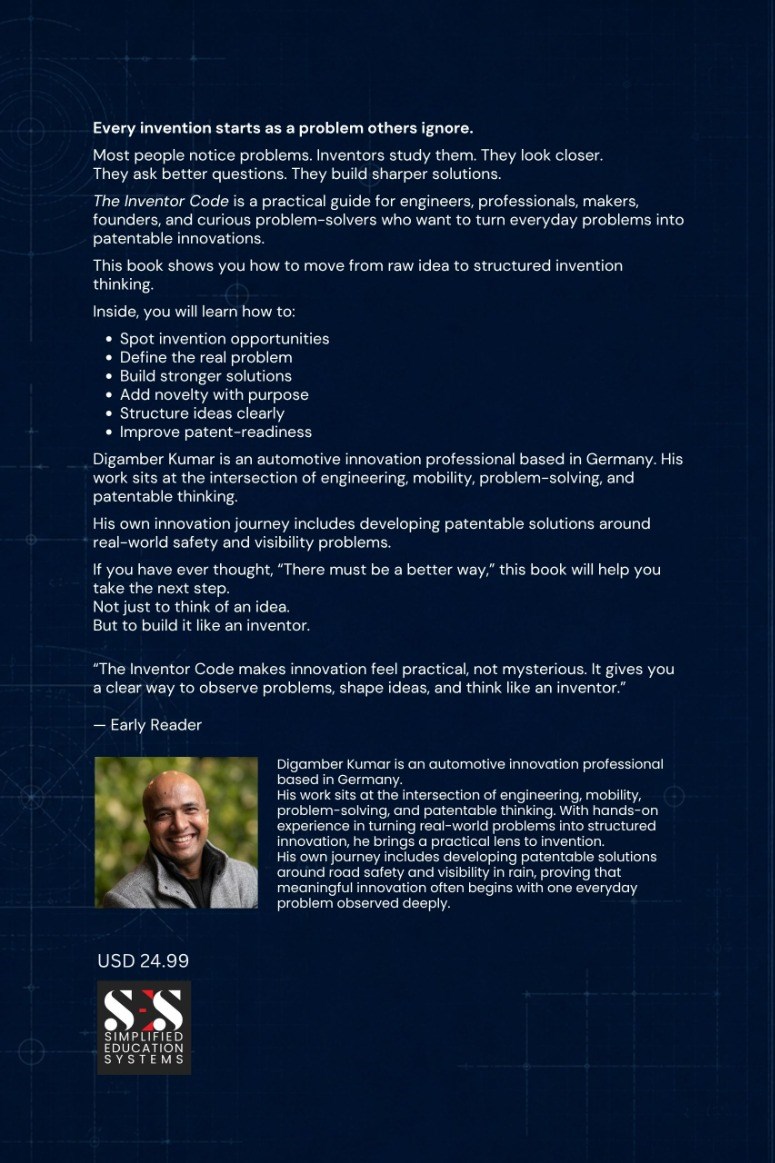
The Inventor Code

Turn Your Idea Into A Protected Invention. A Legal Fence. Yours. Proof You Were First.

Most people have ideas. Few know how to make them stick. This is the book that bridges the gap between a spark of insight and a patent that actually holds — written for engineers, entrepreneurs, and first-time inventors who refuse to let their best ideas go unprotected.

Preorder The Inventor Code

The $1.99 decision that protects your best idea.
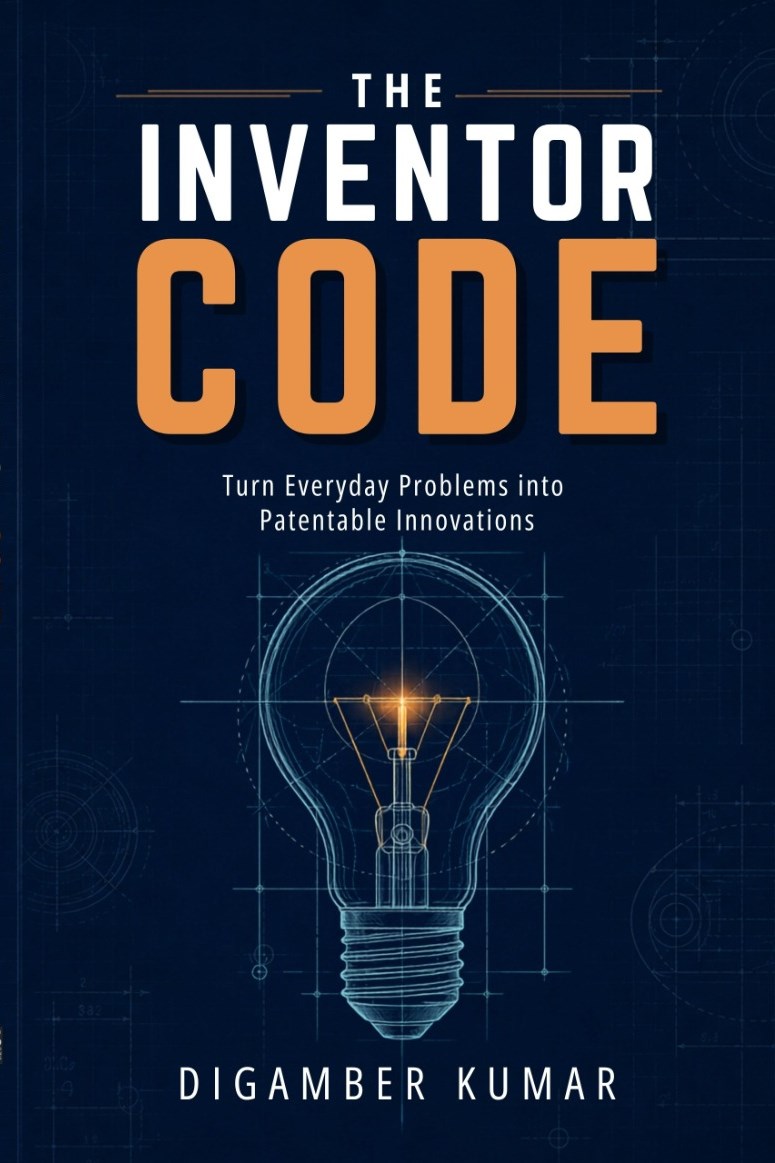
The Author
Digamber Kumar
Meet the Author
Digamber Kumar
✦ Innovation Strategist & Patent Expert

Digamber Kumar has spent 18 years at the intersection of invention, intellectual property, and practical innovation strategy. His work has helped engineers, founders, and researchers transform raw ideas into protected, commercially viable inventions across industries.

18 patents filed, 4 granted, 1 in production
Founder, RuberSoft — driving technology through innovation
Speaker at Tech Night Cologne

"Novelty often does not come from a completely new idea. It comes from a new way of combining and executing existing elements."

— Digamber Kumar, Chapter 6
Why Most Inventors Fail

Having an idea is not enough.

Every year, thousands of brilliant ideas die in notebooks. Not because the idea was bad — but because the inventor didn't know what to do next.

Good Ideas Die Early

Most people have ideas — and immediately dismiss them. Self-doubt, a silent environment, and zero ownership mean brilliant ideas vanish before they're ever explored.

Solving the Wrong Problem

Smart people invest months building solutions to problems that don't actually matter — or don't reflect a real need anyone cares enough to act on.

Too Abstract to Protect

Ideas that stay at the concept level can never be patented. You cannot protect an intention — only a structured system with defined inputs, steps, and decisions.

No Roadmap to Follow

The patent world has no onboarding. First-time inventors face examiner logic, prior art traps, and filing mistakes — with no structured guide to navigate any of it.

What Changes

What you walk away with
after this book.

Stop losing ideas to self-doubt
Build the Capture × Ownership × Action system that keeps ideas alive.
Notice frictions everyone else walks past
Train your brain to stop filtering out the gaps that become innovations.
Validate problems before you solve them
Know if a problem is truly worth solving before investing a single hour.
Turn a vague concept into a structured invention
Define the method, the inputs, the steps — and make it technically defensible.
Think like a patent examiner
Learn the exact criteria used to judge novelty — and write to meet them.
Know what makes an idea protectable
Shift from idea thinking to claim thinking — the shift that changes everything.
Walk in with a complete invention draft
Arrive at your attorney's office prepared — not with an idea, but a document.
File with your name on the patent
From the first idea to a filed, protected invention — on your own terms.
Your Journey Through This Book
Stage 1
You Have an Idea
Raw, unvalidated, possibly dismissed by yourself before anyone else sees it.
Stage 2
You Learn to See Differently
Spot the frictions others ignore. Validate the problem before you build the solution.
Stage 3
Your Idea Becomes an Invention
Structure it into a technically defensible system. Make it novel, specific, and real.
Stage 4
You Think Like an Examiner
Understand what makes an idea protectable — and write your draft to meet that standard.
Stage 5
Your Name Is on the Patent
A complete invention draft, ready to file. From idea to IP — on your own terms.
Inside the Book

From hopeful inventor
to patented creator.

Each chapter builds on the last — from raw idea to filed invention. No fluff. No filler. Only the frameworks that move you forward.

01
Section I — Ideas to Insight

Why Good Ideas Die Early

Ideas don't fail randomly. They fail in patterns — self-doubt, silence, and a lack of ownership. Learn the Idea Survival Formula: Capture × Ownership × Action.

02
Section I — Ideas to Insight

The Friction You're Ignoring

Your brain is wired to filter out discomfort. Every friction you've stopped noticing is a potential innovation. Learn to override that filter and see what others walk past.

03
Section I — Ideas to Insight

Seeing Problems Others Miss

Build the habit of deliberate observation. The world is full of problems hiding in plain sight — visible only to those who train themselves to look.

04
Section II — Insight to Invention

The Wrong Problem Mistake

Even strong ideas and patented solutions can fail to create impact. Learn to validate whether a problem is truly worth solving before investing a single hour.

05
Section II — Insight to Invention

Finding the Real Need

Identifying a problem is not enough. This chapter teaches you to go deeper — to the underlying need that makes a solution worth building and worth protecting.

06
The Turning Point ✦

When an Idea Becomes Novel

Novelty lives in the method and system — not the concept. Learn to structure your solution into a technically defensible invention that a patent examiner can evaluate.

07
Section III — Invention to Patent

How Patent Examiners Think

Stop thinking like an inventor. Start thinking like an examiner. Learn the exact criteria used to evaluate novelty — and how to write your invention to meet them.

08
Section III — Invention to Patent

What Makes an Idea Protectable

An idea is not protectable. A precisely defined technical solution is. This chapter makes the shift from idea thinking to claim thinking — the shift that changes everything.

09
Section III — Invention to Patent

From Idea to Filed Patent

Take your invention and convert it into a structured draft ready to hand to your IP team or attorney. This is what to write, and how to think while writing it.

✦ Kindle Preorder Opens Soon

The Inventor Code
Get Your Copy.

◈ Nine Chapters + Toolkit

Nine tightly structured chapters plus a practical innovation toolkit you can put to work immediately.

⚙ A Daily Method

A method you apply to your everyday work — building an innovative mindset, not just a one-time idea.

✦ Built for Everyone

Not just for engineers. What you need isn't a technical background — it's the method.

Kindle price $9.90$1.99 preorder price
Kindle edition — $1.99 introductory preorder price
Questions

Common questions.

Yes — it's designed specifically for people who have an idea but don't know the formal process. No legal background is assumed. If you have an invention and want to understand what makes it patentable, this book is your starting point.

Most patent books are written by attorneys and focus on legal procedure. This one is written for inventors and focuses on the thinking process — how to structure an idea into something technically novel and defensible, before you ever talk to an attorney.

No. The frameworks work for any field — software, mechanical, process-based, or product inventions. The core skill being taught is structured thinking, which applies universally to any inventor in any domain.

Most readers finish in 3–5 focused hours. The frameworks, however, are ones you'll return to repeatedly as you develop your invention. It's not a book you read once — it's a reference you keep.

Yes — the preorder is currently for the Kindle edition, at an introductory price of $1.99 (regular Kindle price $9.90). A print edition is planned, with details announced separately.

That's a valuable outcome too. Knowing early saves you time, money, and energy. And the same frameworks that reveal a gap also help you reshape your solution into something that is novel. Many readers find their second iteration is the one that gets filed.

✦ Kindle Preorder Opens Soon

"The only thing standing between your idea and a patent is the decision to understand it properly."

Claim Your Copy.
Before Launch.

Nine chapters and a working toolkit — the same method behind 18 filed patents, written for your first one.

✦ Kindle edition — $1.99 introductory preorder price